

A-Series Flat Rocker Circuit Breaker - Single Pole 15A
7403


Features
- Rocker actuator is flush in the “ON” position, eliminating the risk of accidential switching
- Color actuator indicates “OFF” position
- “Trip Free” design cannot be held “ON” during fault current condition
- 2 different actuator styles available
- Prevents accidental switching of 24 hour circuits
- International ON/OFF symbols support vertical or horizontal mounting
Documents
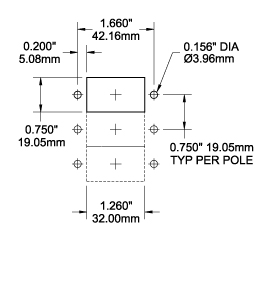 Cutout Templates
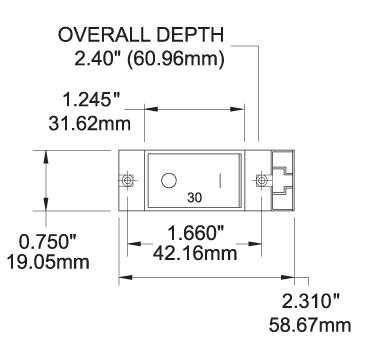 Dimensioned Drawing
 Flat Actuator Circuit Breaker Designs Provide Protection From Accidental Switching
 CE Certificate for A-Series Circuit Breakers
Specifications
| Amperage | 15A AC 15A DC |
Actuator Style  | Flat Rocker |
| Poles | 1 |
| Maximum Voltage | 240V AC 32V DC |
| Circuit Breaker Type | Magnetic Hydraulic - trip free |
| Interrupt Capacity | 3000A @ 125V AC 1500A @ 240V AC 5000A @ 32V DC |
| Minimum Operating Temperature | -40° C |
| Maximum Operating Temperature | 85° C |
| Mounting Screw | #6-32 Stainless Steel |
| Mounting Screw Torque | 6 in-lb (0.68 Nm) |
| Screw Terminal Torque | 14 in-lb (1.58 Nm) |
| Switching Cycles | 10000 |
| Terminal Screws | #10-32 Stainless Steel |
| Weight | 0.16lb (0.07 kg) |
| Weight | 0.18lb (0.08 kg) |
Regulatory Specifications
    |
Trip Delay Curve

Similar Products


Frequently Asked Questions
Q: What size CPD (Circuit Protection Device) is required?
A: The short answer is that the CPD (Circuit Protection Device) should be rated to open at an amperage that is greater than the maximum load the circuit will carry and smaller than the rated amperage capacity of the wire in the circuit. We recommend choosing a size as close to, but not greater than, the amperage capacity of the wire.
Use our Circuit Wizard to find what circuit protection would work best for your application.
Use our Circuit Wizard to find what circuit protection would work best for your application.
Q: Are fuses and circuit breakers interchangeable?
A: The short answer is yes. The longer and more accurate answer is more complex and beyond the scope of this discussion. As amperage ratings increase, circuit breakers become relatively more expensive than fuses. Generally, fuses are less expensive for a given rating, but circuit breakers are re-settable and don’t require the purchase of spares, as do fuses. Also, circuit breakers can be used as switches.
Q: How do fuses and circuit breakers differ?
A: Fuses are thermal devices that open the circuit by utilizing a “fusible link” that melts at a known amperage in a known length of time. Circuit breakers can be either thermal or magnetic devices or a combination of the two.
Q: How does the CPD (Circuit Protection Device) stop the amperage flow?
A: There are two primary methods that CPD’s use to determine that excess amperage is flowing in a circuit. Thermal devices open to break the circuit and stop the current flow in response to heat generated by the excess amperage. Magnetic devices react to a magnetic field created by excess amperage.
Q: Why is Opening Speed Important?
A: When a circuit is activated, there is an initial surge of current (amperage) that the CPD must allow to pass without tripping the CPD. The two screen reprints below from the Blue Sea Systems’ testing system illustrate the difference in inrush currents between inductive (like motors) and resistive (like light bulbs) loads.
Notice that the ratio of normal running current (represented by the flat portion of the amperage line) between the inductive and the resistive graphs varies dramatically. The 17A inductive load initially drew 80 A or 470%, whereas the 44A resistive load initially drew only 126A or 286% of its normal operating current. Such inrush currents must be considered when sizing CPD’s. Each Blue Sea Systems’ CPD has a time/current chart shown on its catalog page.
We recommend sizing fuses and circuit breakers for 5X multiples for inductive loads and 3X multiples for resistive loads and assuming this inrush for approximately .5 seconds.
Notice that the ratio of normal running current (represented by the flat portion of the amperage line) between the inductive and the resistive graphs varies dramatically. The 17A inductive load initially drew 80 A or 470%, whereas the 44A resistive load initially drew only 126A or 286% of its normal operating current. Such inrush currents must be considered when sizing CPD’s. Each Blue Sea Systems’ CPD has a time/current chart shown on its catalog page.
We recommend sizing fuses and circuit breakers for 5X multiples for inductive loads and 3X multiples for resistive loads and assuming this inrush for approximately .5 seconds.
Inductive Load

Resitive Load


